Showing posts with label nerve grafting. Show all posts

Friday, June 30, 2017

Sural nerve harvest - no big deal, right?

Sural nerve harvest - no big deal, right?

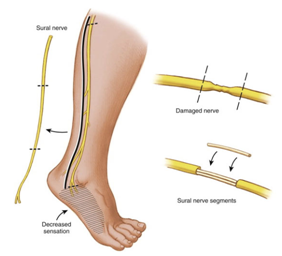
Image result for cabled graft nerveI wanted to write something about sural nerve harvest because it is something I discuss with patients nearly every time we are talking about treatment of nerve injuries. We will often use the sural nerve as an autograft during nerve reconstruction cases. After we remove the scarred/injured part of the nerve, there is usually a gap that we cannot repair directly. We will suture the sural nerve graft to bridge the gap between the nerve ends, often laying down multiple segments of the graft ("cabling" the graft) to replicate the thickness of the nerve we are replacing.

How is the sural nerve harvested? The nerve is identified through either one long incision or a series of small incisions along the back of the calf (just behind the smaller bone in the shin - the fibula). The nerve is identified near the ankle level and traced up to the knee level. After the sural nerve is cleared from the surrounding tissue, the nerve is cut, removed from the body, and prepared for grafting.

What are the downsides of harvesting the sural nerve? Like they say, there's no free lunch.
Image result for sural nerve
  • Numbness: The sural nerve's normal function is to provide sensation to the back of the calf and the outer border of the foot (area seen in purple). Removing the sural nerve will lead to numbness in this area, which is most noticed when walking barefoot or in sandals, or when playing sports like soccer/football that require contact with the outside of the foot. All patients will almost certainly experience this. 
  • Pain: Anytime a nerve is cut (including for a harvest), the nerve ends are very sensitive since they are trying to regenerate. Most of the time, the near-end of the nerve retracts into the calf muscles and doesn't see much irritation since it is buried so deeply. But in some patients (about 5%), the nerve can be very sensitive (painful neuroma). Most of the time, this will get better over time (about 3-6 months). Medications for nerve pain may be helpful. Very rarely, another surgery is needed to re-cut the nerve ends and bury them deep in muscle or bone.
  • Infection, hematoma, wound healing problems, and blood clots (deep venous thrombosis) - these can happen in any leg surgery and certainly need to be mentioned. 
Does the numbeness ever get better? Over time, the numbness will eventually decrease as the remaining nerves grow into the area that the sural nerve used to supply. It will never feel "normal", but eventually will lead to the ability to tell the difference between hot and cold (what we call protective sensation)... except in kids, who often times cannot tell a difference because their nerves grow so quickly.

Are there any other options? Nerve grafts can be harvested from other sources (such as the saphenous nerve in the thigh, the medial antebrachial cutaneous nerve around the elbow, and the posterior interosseous nerve in the wrist) instead of (or in addition to) the sural nerve. The sural nerve tends to be many surgeons' preferred choice (including mine) because it has the highest percentage of nerve fibers (fascicles), a lot of graft can be harvested (up to 35-40cm), and the downsides seem to be tolerated well. Cadaver nerve graft (allograft) is another option, but the studies are still being done to show if it is "good enough" when compared to using the patient's own nerve (autograft). One of the biggest issues with the allograft is that the process to make the allograft non-reactive and non-infectious removes some of the cells that promote nerve regeneration (Schwann cells).


Christopher J. Dy, MD MPH
My Bio at Washington University Orthopedics
dyc@wudosis.wustl.edu 

Wednesday, January 6, 2016

Timing is Everything...

"We will refer the patient for a brachial plexus surgery evaluation, although they will not do surgery until a year after the injury..."

This is a direct quote from the chart of a patient referred to me by a neurologist and an orthopaedic surgeon in another state. To me, this is maddening - absolutely drives me nuts! For that particular patient's injury, waiting more than a year to do the surgery would have left us with minimal chance of success after a nerve reconstruction.

Timing is incredibly important in the treatment of traumatic brachial plexus injuries. I often find myself discussing the importance of timing of treatment with both patients and referring physicians, so I thought this would be a good place to share my thoughts.

After a traumatic nerve injury occurs, the clock starts ticking. When a muscle no longer receives input from a nerve, it can become atrophic - essentially, when it has no signal to perform its function, it withers away. These changes are evident in human muscle at approximately 3 months - sometimes sooner, sometimes later. Somewhere around 12 months, these changes become irreversible, leaving the muscle essentially useless - even if you are able to establish a good nerve signal into the muscle with surgery or spontaneous recovery. At the same time as the muscle withers away, the distal part of the injured nerve (the part of the nerve "downstream" from the injury) also starts to degenerate. This makes it even harder to reconstruct a nerve injury after a long period of time, whether you excise and replace the injured nerve with a nerve graft or bypass the injured nerve with a nerve transfer.

What I wrote above it based on a number of animal studies and laboratory studies of human tissue, but has also been borne out in the clinical experience. While brachial plexus injuries (and this "timing" issue, in particular) are really tough to study with rigorous clinical trials, the collective experience and case series from multiple surgeons reflect that there is a relationship between clinical outcomes and timing of surgery - essentially, the sooner the better.

I prefer to see any patient with a brachial plexus injury or complex peripheral nerve injury as soon after the injury as possible. A pretty good number of these injuries may get better on their own without surgery - with careful watching, repeated examinations, and physical therapy. I would rather have a patient go through that process with me from as close to "day 1" as possible, so that if the recovery is inadequate by 3 months (or 5 months, etc... depending on the specifics of the case), we can be ready to intervene surgically at a time that is optimized for success.


Monday, December 28, 2015

Why I Treat Patients with Brachial Plexus Injuries

When I was recruited to join the faculty of the Peterson Hand Center at Washington University Orthopedics, I was thrilled - and for good reason, as it is one of the premier orthopaedic hand surgery divisions in the world. I immediately told several friends and colleagues from around the country, who shared my excitement, then asked a followup question - what was my area of subspecialty focus? When I would enthusiastically reply "brachial plexus  surgery", I was sometimes greeted by an interesting response - a quizzical look with a subdued shade of pity, paired with "Oooh... Why?"

Although I hardly agree, I can certainly understand why some surgeons do not want to treat patients with brachial plexus injuries - the circumstances are often unfavorable; the surgeries are long, tedious, and can be exhausting; and the outcomes are far from certain. Interestingly, these are some of the same things that I love about treating patients with brachial plexus injuries. From a purely "medical" perspective, I love the challenge of diagnosing the exact injury, figuring out the best treatment plan, seeing the breathtaking anatomy, and performing a surgery that intimidates others. But to be honest, the most rewarding part of it all is when the patient realizes the surgery has worked. After months and sometimes years of being told that they won't be able to use their arm at all, going through a ton of tests and doctors visits, and summoning up the courage to go through a long surgery (sometimes two or more), the patient can feel that things are getting better and that their motion and strength are improving. While this improvement certainly occurs over a long period of time, that initial feeling alone is enough to inspire hope and begin undoing months of pessimism and second guessing. I will never forget the ecstatic impression of my first patient who regained motion in his fingers after a tough nerve injury with a less-than-certain prognosis, and I can guarantee that the feeling never gets old for me. So that look - the initial, unfiltered "wow, that muscle is working!" look - that is why I love treating patients with brachial plexus injuries.